
6 MIN READ
How to future-proof your cell therapy manufacturing strategy
And why flexible manufacturing architecture is the key.

Jason Jones
Head of Global Business Development
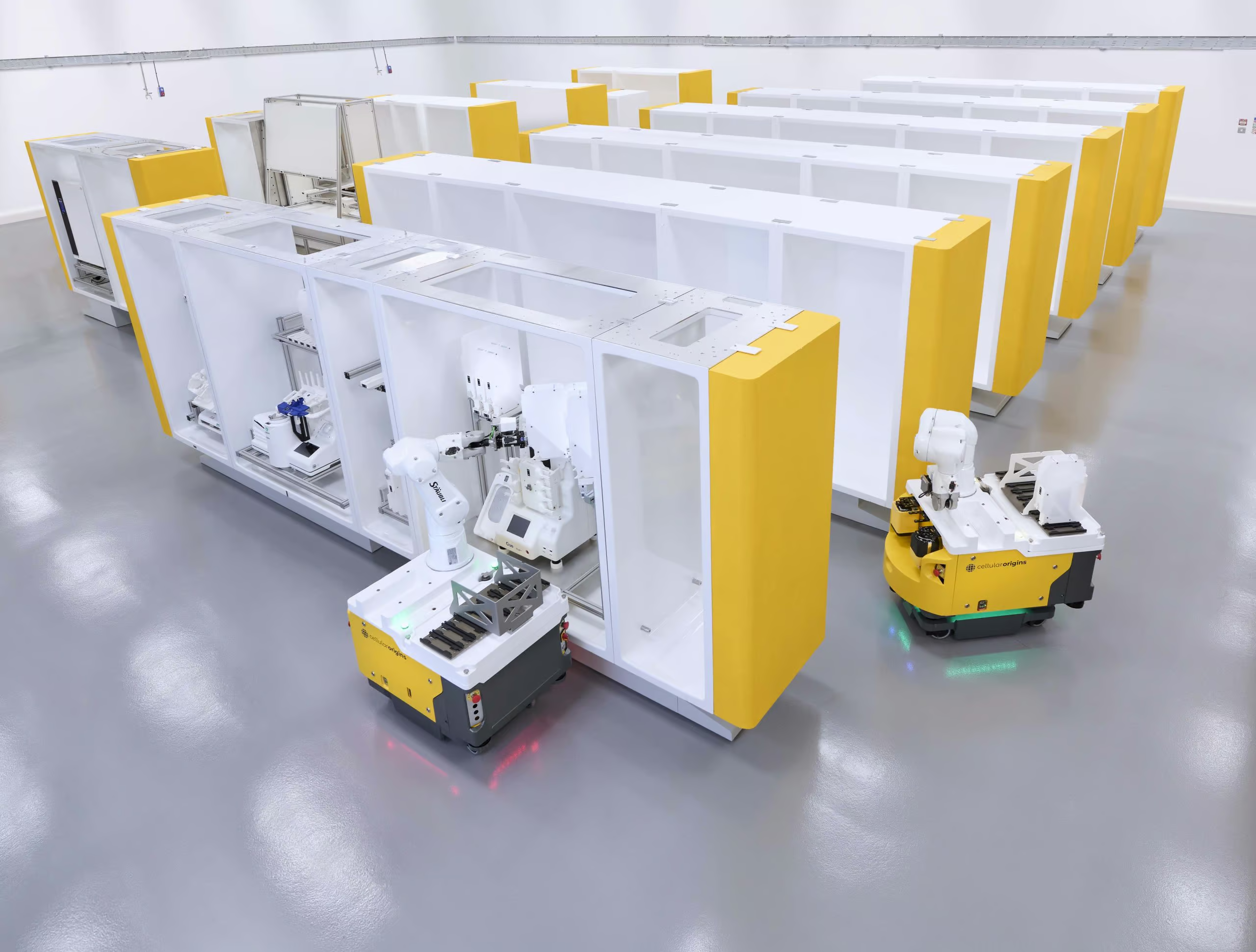
As cell therapies move closer to commercial reality, clinical performance alone will not guarantee success. To achieve broad adoption, developers and manufacturers will need to scale production economically, reduce COGS and keep pace with innovation as demand rises. But how?
As attention turns from proving efficacy to manufacturing therapies at larger volumes, the question for most is no longer whether to automate cell therapy manufacturing, but how the automation platform they choose will support long-term commercial success.
Whether choosing to conduct manufacturing in-house or outsource to a partner, developers need a manufacturing system that not only delivers reliable biological performance, but that can scale efficiently and evolve with their needs. It’s therefore critical that we look beyond immediate process and capacity requirements and evaluate how a system will scale over the next five, ten, or fifteen years, for entire product pipelines.
This is where flexible manufacturing architecture enters the picture.
What does it mean for cell therapy manufacturing architecture to be ‘flexible’?
‘Flexible’ architecture describes cell therapy manufacturing systems that can evolve with changing requirements. Rather than being locked into fixed infrastructure (that must be replicated or redesigned to increase output), flexible manufacturing systems enable developers to add capacity incrementally and optimise operations without duplicating or redesigning the entire manufacturing operation.
In practical terms, it allows developers and manufacturers to:
- Add manufacturing capacity incrementally as demand grows, reducing capital risk and avoiding large step changes in infrastructure investment;
- Achieve necessary economies of scale by expanding with one efficient, coordinated system, rather than numerous disconnected manufacturing units; and
- Keep pace with innovation to support the entire product pipeline, by introducing process improvements over time, without rebuilding operations.
Automation platforms which can provide this flexibility will support scale-up while controlling risk, costs, and operational complexity.
Ensure you can adapt to changing market conditions
The commercial trajectory of any cell therapy is difficult to predict. As patient access grows, demand will inevitably fluctuate in response to factors such as reimbursement agreements, or expansion into new markets. Responding to unpredictable changes in demand requires manufacturing infrastructure that can adapt.
If production capacity can only be added in large, costly increments, developers are forced to make capacity decisions before demand is fully understood. For example, with pod-based cell therapy manufacturing systems – where capacity is added with the purchase of an entire new unit – developers must either risk large capital investment in potentially underutilised capacity, or risk insufficient capacity to meet demand. In many cases, adding additional pods also requires expanding the facility footprint or manufacturing space, introducing additional costs.
Flexible cell therapy manufacturing platforms – such as Constellation® - are designed to enable incremental, low-risk scale-up. The Constellation system is comprised of modular workstations, which contain trusted bioprocessing instruments operated by mobile robotics. Adding capacity is therefore as simple as adding additional workstations to the facility, to increase throughput at specific process steps where capacity constraints emerge. Rather than duplicating an entire manufacturing system, this allows throughput to be increased a controlled and cost-efficient way.
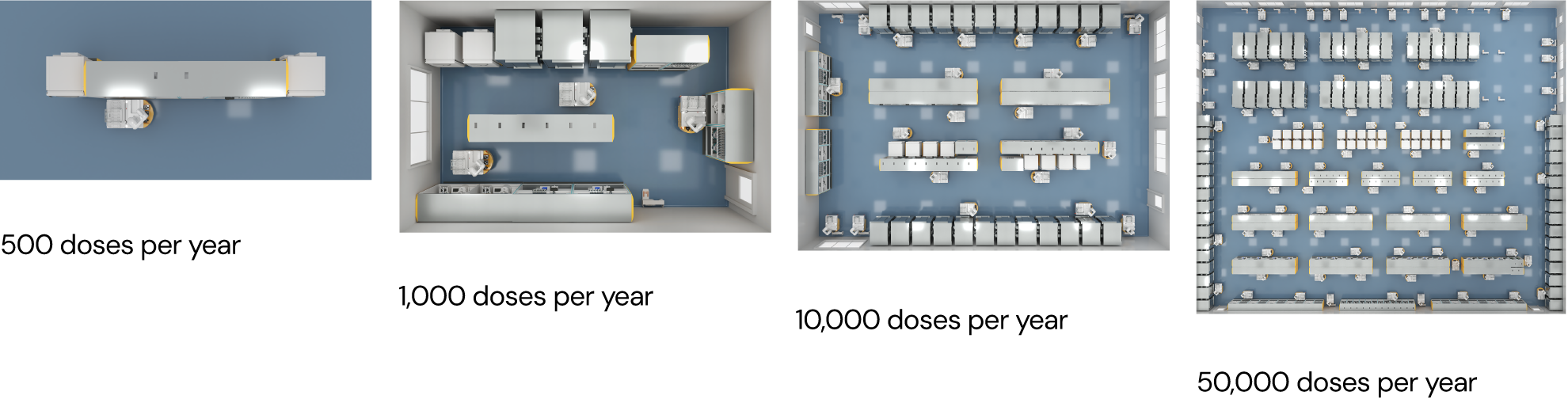
Example Constellation® facility configurations at increasing production volumes. Renders illustrate how the platform evolves by adding workstations where needed, all within a single, coordinated manufacturing environment.
Because expansion can be incremental, investment can therefore be aligned more closely with real demand and facilities can adapt as requirements evolve. This not only reduces capex risk, but provides the operational agility needed to respond to changing market conditions. This is one of the key ways flexible cell therapy manufacturing architecture will support long-term commercial success.
Harness economies of scale to reduce cost-per-dose as production scales
Capacity planning is only one part of the scale-up challenge. Commercially viable cell therapy manufacturing must also achieve sufficient cost efficiencies and economies of scale to lower COGS. The goal is not simply to produce more therapies, but to reduce cost-per-dose while preserving process consistency and biological performance.
As production volumes rise, so does the burden of manufacturing operations and oversight. More batches must be coordinated, production security ensured, equipment maintained and data securely managed. However, as production scales, there will also emerge opportunities to improve resource utilisation, reduce operating costs, and capture economies of scale – all of which will be crucial for profitably delivering therapies in the long-term.
Flexible cell therapy manufacturing architecture is critical to realising these efficiencies, because it allows production to scale within the same, unified system. Constellation’s flexible infrastructure means manufacturing can scale from clinical (100s of doses) to commercial-scale production (1,000s-10,000s+ of doses) within a single platform and manufacturing facility. As capacity is added via configurable workstations, the wider manufacturing operation remains connected through unified orchestration, scheduling, and quality control.
This results in:
- Optimal utilisation of resources and capacity across the whole manufacturing operation
- Parallel execution of workflows, enabling multiple batches and even different therapies to be manufactured simultaneously
- System-wide visibility of batches and manufacturing data
- Minimal management complexity
- High operational resilience and production continuity, as manufacturing can continue when individual workstations are offline for maintenance
As output increases, the system remains manageable, efficient and resilient.
This differs from manufacturing approaches that scale by duplicating self-contained production units. While adding units does increase throughput, operating numerous, largely independent manufacturing units quickly becomes problematic at scale. The challenge is not just duplicated infrastructure and labour, which adds complexity and operating cost. The lack of coordination across different units means developers are effectively running multiple small, separate factories, instead of one integrated, efficient operation.
This coordination issue is detrimental to commercial viability because many of the efficiencies associated with scale depend on the system being able to optimise resources across the entire operation, for maximum hardware and facility utility. When manufacturing units are separate, capacity cannot be shared across units, leading to excess downtime on some unit operations and decreased utilisation. Bottlenecks remain localised and - as more units are added, operational complexity grows alongside output. This hugely limits the efficiencies that could be realised - preventing reduction in COGS.
The most effective manufacturing platforms will do more than increase throughput. They will deliver the operational efficiency and coordination needed for long-term commercial viability.
Keep pace with innovation
Finally, manufacturing flexibility is key to success because it will equip cell therapy developers and manufacturers to adopt innovations over time. In the coming decades, the cell therapy industry will continue to advance. New technologies will become available. Opportunities to improve throughput, quality, and efficiency will emerge. The winners in this industry will be those who can keep pace.
Manufacturing systems built around fixed architectures will make this evolution difficult. Introducing new technologies could require significant modifications to infrastructure – disruptive at best and prohibitively expensive at worst. The effort and disruption involved are likely to prohibit adoption of innovations altogether, whether for current products or upcoming pipeline products.
Flexible cell therapy manufacturing architectures are designed differently.
For example, Constellation uses configurable workstations within an open-plan manufacturing environment. This allows new technologies to be integrated and existing tools replaced without redesigning the entire manufacturing operation. Manufacturers have greater freedom to adapt their manufacturing as business needs evolve, without disrupting wider manufacturing operations.
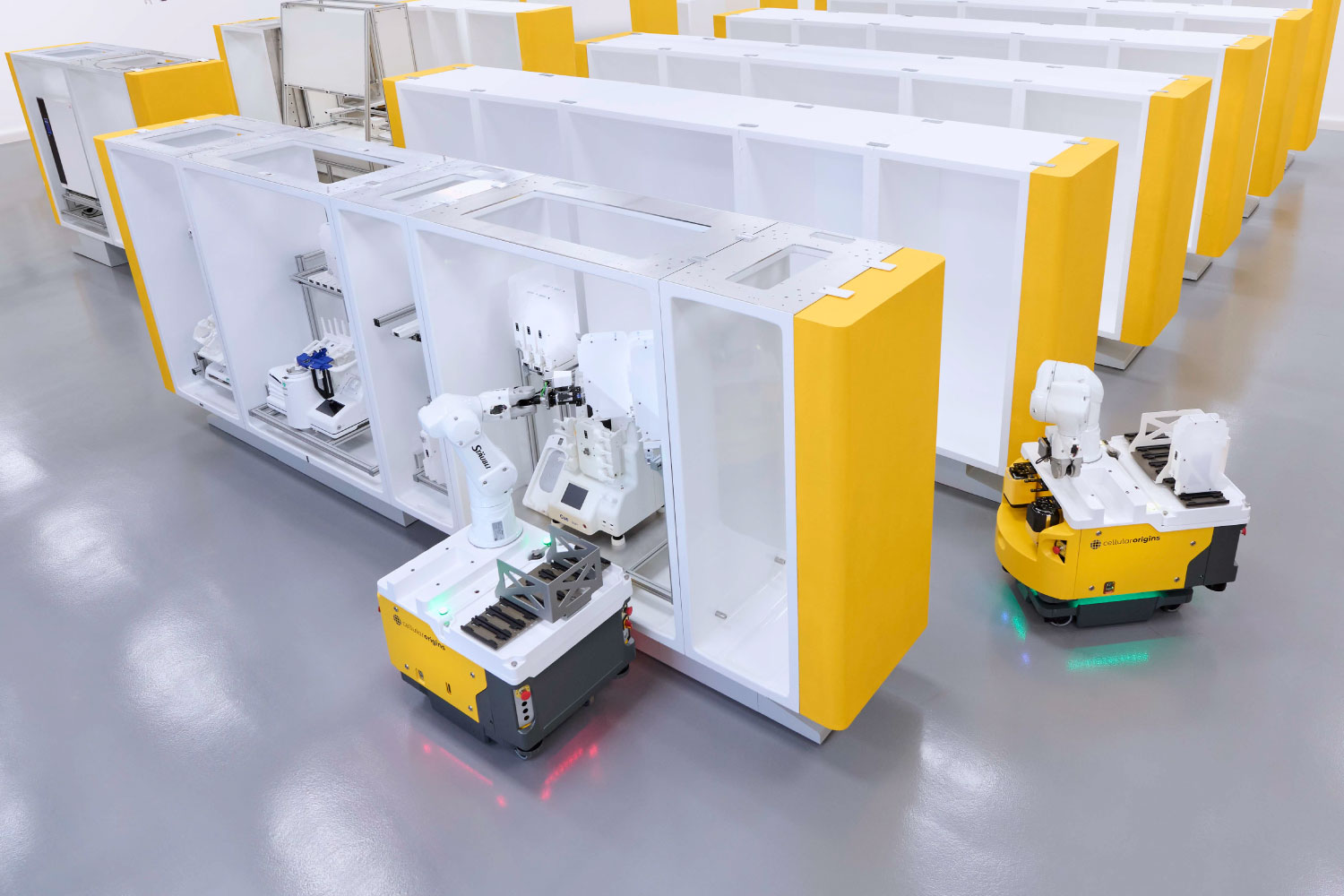
Cellular Origins’ pilot cell therapy manufacturing facility in Cambridge, UK. Mobile robots move cell material between bioprocessing instrument workstations.
As the industry matures, the organisations that can rapidly adopt innovation will sustain competitive advantage. Choosing a manufacturing platform that can evolve alongside the technology landscape will therefore be critical to long-term success.
As cell therapy developers and manufacturers prepare for manufacturing scale-up, their choice of manufacturing platform will influence far more than near-term production capacity. It will shape how manufacturing responds to changing demand, how efficiently operations scale over time, and how easily new technologies can be adopted as the industry evolves.
For organisations pursuing long-term commercial success, flexible cell therapy manufacturing will be essential to scaling capacity, reducing cost-per-dose, and maintaining competitiveness as technologies continue to evolve. Manufacturing must grow with you.
Considering the future of your cell therapy manufacturing? Arrange a discovery call.
We'll be in touch!
The Constellation® platform.
Constellation is a fully automated robotic platform enabling flexible, low-risk manufacturing expansion for autologous and allogeneic cell therapies. It integrates seamlessly with validated GMP instruments and consumables, to preserve biological performance, with digital orchestration for real-time monitoring and full traceability.
Automate your cell therapy manufacturing with confidence and achieve greater throughput, consistency, and operational efficiency at lower costs.